
Three problems, one sales enablement foundation
A sales enablement foundation that aligned wholesaler activity, sharpened the message, and restarted the growth that had stalled.
Client: Canadian B2B financial services (name withheld)
Sector: B2B financial services
Stage: Established firm, wholesaler-driven distribution
Foundation addressed: Message Coherence, Operational Readiness, Conversion Integrity
Engagement scope: Sales enablement model, repositioning, wholesaler methodology, CRM and pipeline infrastructure
The Situation
This Canadian B2B financial services firm had the fundamentals of a good business. Long-standing client relationships. A broad product suite. A capable internal team. Growth had slowed, and not for lack of effort. Wholesalers were working hard, marketing was producing, and leadership was stuck asking what was not landing.
The firm was not in trouble. It was ready to scale smarter, but the operational layer underneath the sales function was working in the background against the team.
The Challenge
The diagnostic surfaced three problems operating at the same time, each one limiting the others.
Meeting efficiency was broken. Wholesalers were booking meetings geographically at random. A day's schedule could look like driving to one town for a single meeting, then driving across the province for another. Two meetings a day was typical when the math of the business supported four to six. The team was on the road. The time on the road was not producing what it should have been.
Every wholesaler was telling a different story. There was no shared methodology for how the product was sold. No consistent materials. No agreed-upon language. Which meant every advisor and every institutional buyer was hearing a different version of what the firm was and what the product did. And the version marketing was running in campaigns was different again. The story was not traveling, because there was no single story to travel.
There was no mechanism for asking for the business. Wholesalers were having meetings, building relationships, and presenting products. What was missing was the structured moment each quarter where the ask was made, the commitment was captured, and the follow-up closed the loop on whether commitments actually turned into sales. The firm had relationships, but no pipeline discipline.
Each problem on its own would have slowed growth. Together, they had stopped it.
The Work
The foundation this firm needed was not a brand refresh. It was a sales enablement model that rebuilt the operational layer between wholesalers, marketing, and leadership.
I led the development of the full model. The work moved in sequence.
A sharper, more modern narrative came first, built to speak directly to the real decision drivers of today's B2B buyer. From there, the ideal customer profile was clarified and the market was segmented so wholesaler time could go to high-fit, high-conversion opportunities rather than everything the field could chase.
Messaging was rebuilt across touchpoints: sales decks, campaigns, outbound sequences, wholesaler materials. The goal was that the story sounded the same whether an advisor encountered it through a campaign, a wholesaler meeting, or a follow-up email. No wholesaler improvising. No marketing drift. One narrative, told with conviction across the full footprint.
A centralized CRM with predictive modelling came next, built to prioritize leads, give wholesalers real-time guidance in the field, and make pipeline visible to leadership for the first time. Wholesaler geography could now be coordinated around meeting density rather than booked at random.
The final and most important layer was the sales methodology itself. A structured quarterly commitment model replaced the pattern of open-ended meetings. Wholesalers were trained to ask for the business directly, capture the commitment, and follow up on whether the commitment turned into placed business. A unified go-to-market playbook pulled everything together so sales and marketing were executing from the same strategy, with shared goals and shared accountability.
Foundations Addressed
Message Coherence, Operational Readiness, and Conversion Integrity
Three of the seven foundations were broken at the same time. Wholesalers were telling different stories. The operational systems were not giving the team the structure to sell effectively. The customer journey had no mechanism for the commitment ask or the follow-up. The work rebuilt all three at once, because none of them could hold on their own.
The Outcome
The growth came back and then some.
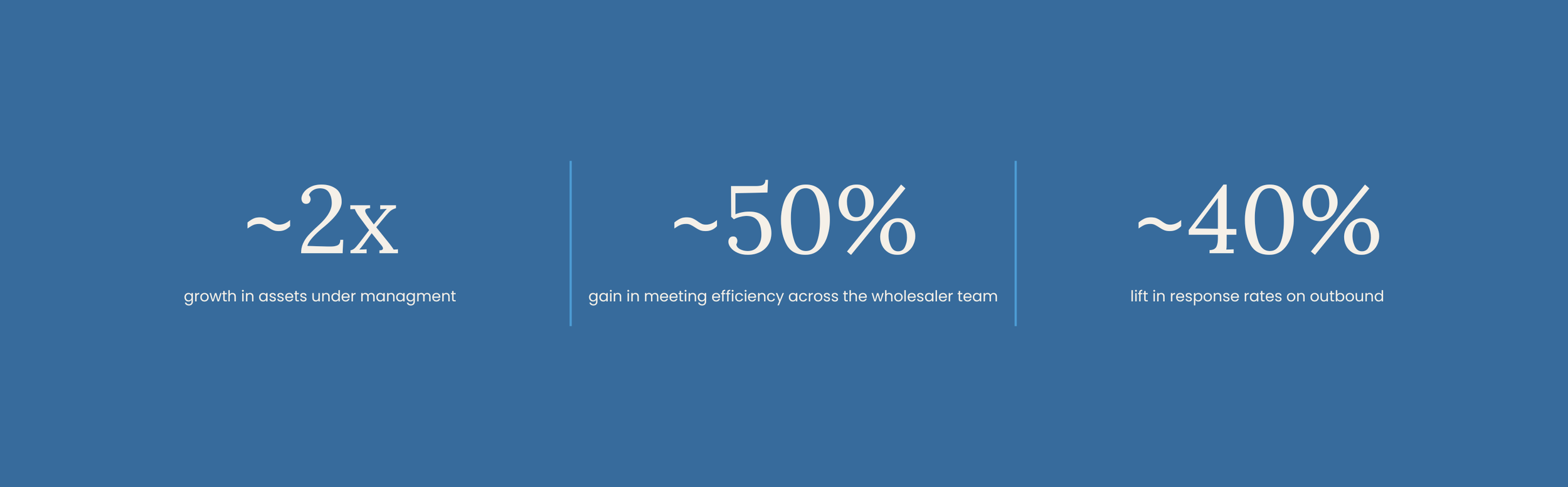
Assets under management had an approximate 50% lift over the engagement period. Meeting efficiency gained around 50%, driven by the combination of geographic coordination and a sharper, better-qualified pipeline. Outbound response rates rose by over 40% as the messaging landed more consistently.
The deeper shift was organizational. Wholesalers went from improvising to executing a shared methodology. Marketing went from producing activity to producing pipeline the sales team could actually convert. Leadership went from asking what was not landing to knowing which levers were moving the business.
“When wholesalers are telling different stories and the operational systems are not behind them, the team can be working hard and still be losing ground. The fix is the foundation underneath them, not more effort on top.”
Is your sales team carrying weight the systems should be holding?
If your wholesalers, sales team, or business development function are working hard without the message, the methodology, or the infrastructure underneath them, the limit is not effort. Book a call and we will talk through what rebuilding the operational foundation would look like for your firm.